Ukemi-SafeFall
Teaching a humanoid robot to fall like a martial artist: rolling to soften the impact, then getting back up on its own.
Co-first author · Accepted to IEEE-RAS Humanoids 2026, to be presented
- When a humanoid can't avoid a fall, reduce how hard it hits the ground and still let it stand back up afterward.
- Train a reinforcement learning policy with rewards inspired by martial-arts breakfalls, plus a learned motion prior that keeps the movements human-like.
- The policy runs on a real 23-joint humanoid across pushes, kicks, trips, and drops. In simulation it cuts peak impact force by 32% and unsafe contacts by 70%, and recovers in 98% of falls.
On the real robot
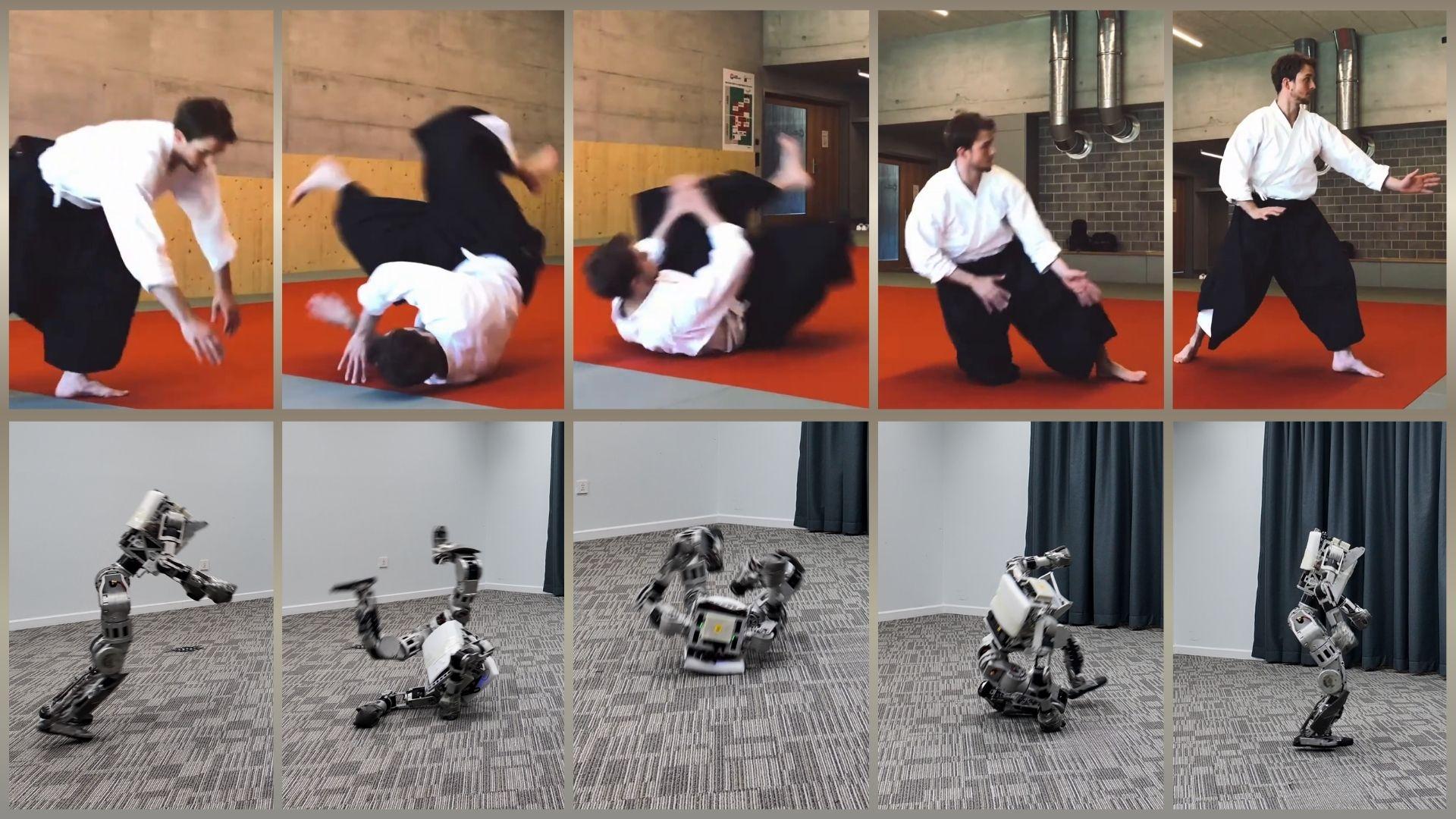
We deployed the policy on our in-house humanoid (23 actuated joints) and knocked it over in different ways. Each time it turns the fall into a roll, spreads the impact across its body, and stands back up on its own.
The hardware runs show the behavior transferring to a real robot. The impact and recovery numbers below are measured in simulation.
Why falling matters
Most humanoid controllers treat a fall as the end of the episode. But real robots do fall. A push, a trip, or a misstep can knock them over, and a hard landing can damage the head, torso, or hips. That leaves an open question: if a fall is unavoidable, how should the robot fall?
Martial artists answer this with ukemi (breakfalls): instead of landing flat, they roll, spread the impact across the body, and come back up ready to move. We wanted the robot to learn the same habit.
In simulation: falling with no control vs. our policy
Same push, same starting pose. Without control the robot just collapses. With Ukemi-SafeFall it rolls through the fall and stands back up.
No control. This is the baseline for uncontrolled falling.
Rolls to spread the impact, then recovers to standing.
How it works
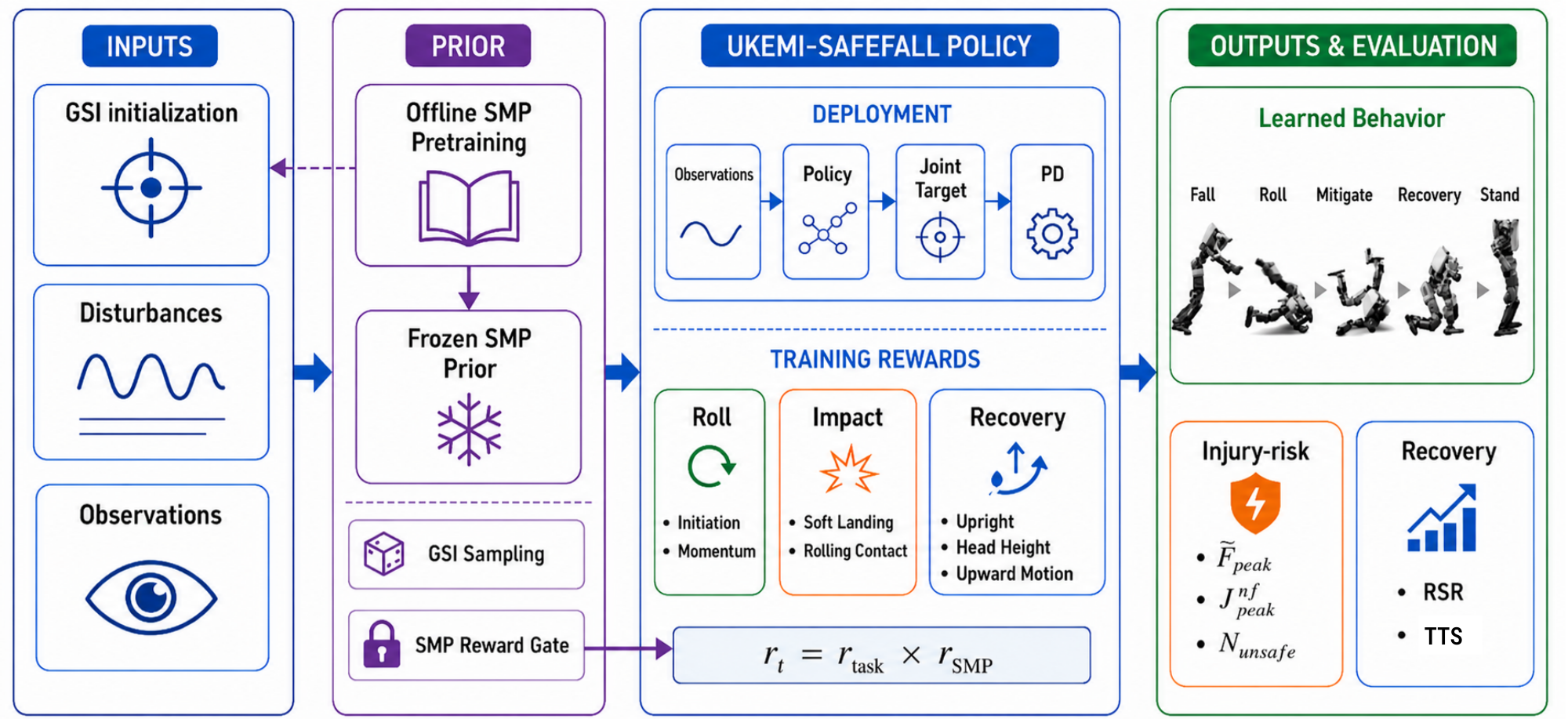
The robot learns by trial and error in simulation (reinforcement learning with PPO). Its rewards are split into three ideas:
- Roll: start a roll and keep the momentum going instead of landing flat.
- Soften the impact: limit how hard the torso and arms hit the ground.
- Recover: get upright and raise the head back to standing height.
These rewards switch on automatically based on how tilted the body is and how low the head is, so the robot doesn't need a separate module to decide which phase of the fall it's in.
On top of that, a diffusion-based Score-Matching Motion Prior, trained on human motion, scores how natural each movement looks. The task reward is multiplied by that score, so the robot only gets full credit for motions that are both safe and human-like. The same prior is also used to generate varied fallen starting poses for training.
What each piece adds
Removing parts of the method shows why each one is there.
Trained only to stand up, with no rolling or impact rewards.
All rewards stay on for the whole episode instead of switching on at the right moment.
Safe-falling rewards without the human-likeness score.
The same falls in simulation
Before going to hardware, we tested the policy in a separate MuJoCo simulator on the same kinds of falls.
Results
Measured over 50 simulated falls per method, compared with falling passively:
- 32% lower peak contact force (relative to body weight)
- 78% lower cumulative impact while on the ground
- 70% fewer unsafe contacts with the head, torso, and pelvis
- 98% of falls end with the robot standing, in 1.04 ± 0.27 s on average

Paper
Anh Duc Tran*, Anh-Quang Vu*, Loc Pham, Trong Hieu Nguyen, Chuong Nguyen Le, Quang Huy Dao, Hoang Vu Dao, Van-Truong Nguyen, Chuong Nguyen, Pham Tuyen Le, Quan Nguyen. Ukemi-SafeFall: An Ukemi-inspired Injury-Aware Falling and Recovery. IEEE-RAS International Conference on Humanoid Robots (Humanoids), 2026. Accepted, to be presented.
* Equal contribution